
Best Low-Volatility Slots in Australia
 Available in US
Explore how volatility, variance and RTP shape session patterns without removing losses or guaranteeing a payout.

Table of Contents
- Low-Volatility Slots: What the Label Really Means
- How Low-Volatility Slot Machines Work
- Low-Volatility Online Slots and the Australian Legal Boundary
- RTP, Variance and the Search for a More Predictable Session
- Low-Volatility Slots from Pragmatic Play
- Low-Volatility Pokies in Australia: What You Can Actually Access
- Finding the Highest-RTP Low-Volatility Slots
- Low-Volatility Slot Games Worth Understanding
- Low-Volatility Slots: A Plain-English Meaning
Low-Volatility Slots: What the Label Really Means
A low-volatility slot is designed around a particular pattern of results: wins tend to arrive more frequently, but the individual payouts tend to be smaller. In Australian gambling language, you may also see this described as low variance. Both labels concern the distribution of results, not whether a game is “safe”, profitable or capable of producing a win on demand.
That distinction matters. A slot can feel steadier because winning combinations appear more regularly, yet the balance can still move up or down from one spin to the next. Low volatility does not remove losing spins, set a minimum payout or protect a bankroll. It describes the kind of outcomes the game is designed to produce over many plays.
What low volatility means in practice
Imagine comparing two broad styles of pokies. A low-volatility game may produce a stream of modest winning combinations, with fewer dramatic gaps between payouts. A high-variance game is more likely to go through longer stretches without a win, while offering the possibility of a larger payout when a feature or combination lands.
This page highlights operators worth considering when looking for low-volatility slots in Australia in 2026. Use the available licensing, bonus, deposit, and payout details as practical points of reference when reviewing the options.
License: Curacao eGaming Licence · Min. deposit: A$10 Endon Technologies holds a Curacao eGaming Licence and accepts minimum deposits of A$10. These details make it a straightforward option to consider when reviewing low-volatility slot sites.
License: Curacao eGaming Licence · Min. deposit: A$10 PlayCroco operates under a Curacao eGaming Licence and has a minimum deposit of A$10. It is included as a low-entry option for players assessing available slot operators.
Bonus: up to A$7,500 + 550 free spins across 10 deposits, 50x wagering · Payout speed: crypto under 1 hour, PayID 1-3 business days · Min. deposit: A$20 (A$30 to qualify for the bonus) Ricky Casino offers up to A$7,500 and 550 free spins across 10 deposits, with 50x wagering. Crypto payouts are stated as taking under 1 hour, while PayID payouts take 1–3 business days; the minimum deposit is A$20, or A$30 to qualify for the bonus.
License: Curacao Gaming Control Board OGL/2023/176/0095 (Hollycorn N.V.) · Bonus: up to A$1,500 + 200 free spins across 3 deposits LuckyVibe is licensed by the Curacao Gaming Control Board under OGL/2023/176/0095, with Hollycorn N.V. identified as the license holder. Its welcome offer reaches A$1,500 plus 200 free spins across 3 deposits.
License: Curacao – Antillephone N.V. (Versus Odds B.V.) · Bonus: up to EUR 2,000 across 5 deposits + 200 free spins · Min. deposit: EUR 20 Thor Casino is licensed in Curacao by Antillephone N.V. for Versus Odds B.V. Its promotion offers up to EUR 2,000 across 5 deposits together with 200 free spins, and the minimum deposit is EUR 20.
License: Curacao Gaming Control Board OGL/2023/176/0095 (Hollycorn N.V.) · Bonus: 100% up to A$10,000 + 100 free spins GoldenCrown holds Curacao Gaming Control Board licence OGL/2023/176/0095, with Hollycorn N.V. named in the licensing details. The casino advertises a 100% bonus up to A$10,000 plus 100 free spins.
License: Tobique Gaming Commission · Bonus: up to A$8,000 + 400 free spins across 4 deposits · Payout speed: crypto ~10-15 minutes, fiat 1-5 days · Min. deposit: A$30 SkyCrown operates under a Tobique Gaming Commission licence and offers up to A$8,000 plus 400 free spins across 4 deposits. Crypto payouts are listed at approximately 10–15 minutes and fiat payouts at 1–5 days; the minimum deposit is A$30.
Bonus: 100% up to A$750 + 200 free spins, 35x wagering · Payout speed: crypto 30-120 minutes, fiat 24-72 hours · Min. deposit: A$30 MrPacho offers a 100% bonus up to A$750 plus 200 free spins, with 35x wagering. Crypto payouts are stated at 30–120 minutes and fiat payouts at 24–72 hours, with a minimum deposit of A$30.
License: Curacao, operated by Dama N.V. · Bonus: 325% up to 5.25 BTC + 250 free spins across 4 deposits 7Bit Casino is licensed in Curacao and operated by Dama N.V. Its offer includes a 325% bonus up to 5.25 BTC plus 250 free spins across 4 deposits.
License: Curacao · Bonus: 100% up to A$500 + 200 free spins, 10x wagering · Payout speed: crypto 30-60 minutes, fiat 1-5 days · Min. deposit: A$10 Wild Tokyo operates under a Curacao licence and offers a 100% bonus up to A$500 plus 200 free spins, with 10x wagering. Crypto payouts are listed at 30–60 minutes and fiat payouts at 1–5 days, while the minimum deposit is A$10.
The contrast is not a promise about every short session. A low-volatility game can still produce several losing spins in succession. A high-variance game can also produce small wins. The labels describe the overall mathematical profile rather than dictating the result of a particular sequence.
This is why the phrase “slots with low volatility” should be read as a description of expected payout behaviour, not as a recommendation to increase your stake. The amount wagered changes the financial size of each result, but it does not convert a high-variance game into a low-variance one or make a low-volatility game certain to pay.
Low volatility is not the same as RTP
RTP means Return to Player. It is a long-run statistical average calculated across tens of millions of spins. It is not the amount you are entitled to receive during one visit, one deposit or one session.
Variance and RTP answer different questions:
- Variance describes how payouts are distributed: how often wins tend to occur and how large they tend to be.
- RTP describes the theoretical long-run return used for statistical comparison.
- A session result is what happens during your own finite sequence of spins.
A low-volatility game may have a particular RTP, but the label itself does not reveal that figure. Conversely, two games can show a similar RTP while producing noticeably different playing experiences if their variance profiles differ. One may return more of its theoretical amount through smaller, more frequent wins; another may concentrate more of its potential return in less frequent, larger outcomes.
For that reason, searching for low-volatility RTP slots involves checking both pieces of information where the game provides them. RTP alone cannot tell you whether payouts will be frequent or concentrated. Variance alone cannot tell you the long-run statistical return. Treating either figure as a guarantee is a category error.
What low-volatility slots cannot do
A low-volatility label cannot predict the next winning combination. Online pokies use a Random Number Generator, or RNG, to determine outcomes. The RNG operates independently of time, player traffic and external factors. Each spin is independent, so the previous result has no bearing on the next one.
That rules out several familiar but misleading ideas. A run of losses does not make a win “due”, and a recent large payout does not make the next spin less likely to pay. The game does not remember that you have been playing, nor does it adjust its next result because a particular symbol has not appeared for some time.
The same principle applies to low-volatility games. Their broader statistical profile does not create a sequence that must balance itself during your session. Frequent wins are a tendency in the design and mathematics of the game, not a schedule that the RNG follows spin by spin.
Why the label appeals to some players
The practical attraction is predictability of experience, not certainty of outcome. Smaller and more frequent wins may make the bankroll movement feel less abrupt than in a high-variance pokie. Players who prefer regular feature activity or modest winning combinations may find that profile easier to understand than a game built around rare, larger payouts.
Payout Frequency More frequent wins
Typical Payout Size Smaller amounts
Volatility Profile Low variance
That preference should remain separate from the question of affordability. A low-volatility game can still lose money, and a longer sequence of small wins does not necessarily mean the overall session is positive. The result depends on the relationship between stakes, wins and losses, while the RNG continues to treat every spin independently.
A game review can illustrate the label without turning it into a universal rule. For instance, a specialist game review identifies Starburst as a low-volatility slot featuring expanding wilds. That feature helps explain the game’s presentation, but it does not mean every spin will produce a win or that its result can be inferred from the previous spin.
When you see “low volatility” attached to a pokie, read it as a compact description of payout distribution: more frequent wins with smaller amounts than the high-variance alternative. Then check the stated RTP separately, remember that it is a long-run average, and treat every spin as an independent random event. That is what the label means—and, just as importantly, what it does not mean.
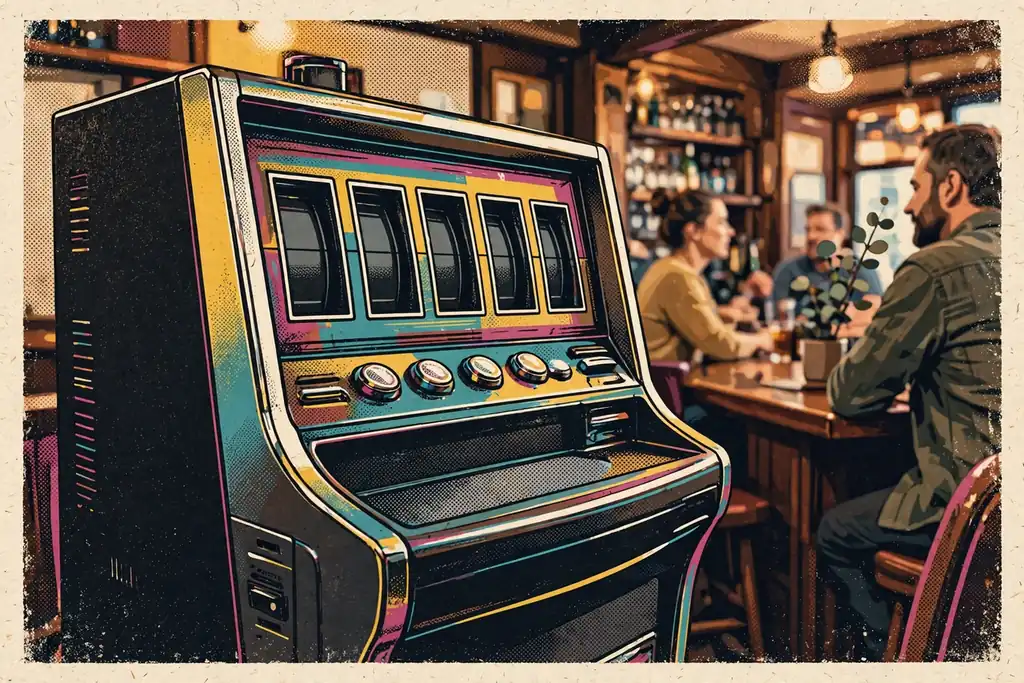
How Low-Volatility Slot Machines Work
A low-volatility slot machine uses the same basic building blocks as other digital pokies. The game software generates a result, displays symbols on digital reels, checks the result against its winning rules, and applies any feature triggered by that combination. The “low-volatility” description concerns how payouts are distributed; it does not mean that the underlying machine follows a different kind of random process.
Digital reels and symbols
Modern online pokies do not need physical wheels turning behind the screen. They use digital reels containing programmed sequences of symbols. When you press the spin button, the game determines the result and presents the corresponding symbols in the reel window.
Those symbols may include regular paying icons and special symbols with additional functions. A wild can substitute for another symbol in a winning combination, subject to the game’s rules. A scatter can trigger a separate feature rather than forming a standard line win. The exact behaviour is not universal, so the paytable and rules are more useful than the artwork on the screen.

A low-volatility design may distribute more modest wins across the base game or its features, but the reels still follow the same programmed rules as any other pokie. A previous result does not alter the next spin, and the appearance of a particular symbol does not create an obligation for the machine to pay.
Paylines and ways to win
The game must also define how symbols become winning combinations. Traditional pokies may use fixed paylines that run across selected positions on the reels. A result wins when matching symbols land in the required positions along one of those lines.
Other games use ways-to-win mechanics. Instead of tracing a fixed line, the game checks matching symbols across adjacent reels or qualifying positions. The number of available ways can change when the reel layout changes. Megaways mechanics are one example: the number of symbols on a reel can vary, changing the number of possible winning arrangements from one spin to another.

These systems affect how wins are identified, not whether a player can predict the next result. They also make the paytable essential reading. You need to know which symbols must appear, whether adjacent reels are required, and whether a win pays once or can be combined with other wins.
Features that change the spin
Low-volatility casino games can contain many of the same features found in higher-variance titles. A lower variance label does not automatically remove bonus rounds, multipliers, or expanding symbols.
Common features include:
- Wild symbols, which may replace regular symbols under stated conditions.
- Scatter symbols, which can activate a bonus feature when the required combination appears.
- Bonus mini-games, where a separate selection or interaction determines an additional result.
- Bonus spins, which give a defined number of feature rounds under the game’s rules.
- Multipliers, which increase a qualifying win by the value stated in the paytable or feature description.
- Cascading reels, where winning symbols disappear and new symbols fall into the spaces.
- Progressive jackpots, where the prize structure can change as qualifying play contributes to the jackpot.
- Megaways mechanics, where changing reel heights create a variable number of ways to win.
A feature can make individual results look more dramatic without changing the basic meaning of low volatility. What matters is the overall distribution of outcomes across the game, not whether the screen includes animated bonus symbols.
Stakes, rules and displayed information
The stake control determines how much is placed on each spin. Online pokie bets may range from a few cents to hundreds of dollars per spin, depending on the game and the settings available. The available stake range is a mechanical property of the title or platform, not evidence that a game is safer or more volatile.
Before playing, the information panel should show the game’s rules and available stake range. It may also display Return to Player information, a volatility or variance description, feature conditions, and stated limits. Not every game presents every item in the same place, so opening the paytable and help screens matters.
Paytable information normally explains the value of symbols, the treatment of wilds and scatters, the conditions for bonus spins, and how multipliers or cascades operate. It should also clarify whether a feature has restrictions or whether a particular win requires a specified arrangement.

Why the screen can be misleading
The animation is presentation, not a prediction tool. Reels may appear to slow down, symbols may land in sequence, and a cascade may create several visual events from one result. None of these effects indicates that the machine is “close” to a win or that the next spin has been improved by previous losses.
For a player comparing slot machines with low volatility, the useful questions are mechanical: how are wins formed, which features can be triggered, what does each symbol do, and what limits are stated in the rules? The low-volatility label describes the pattern of payouts; the digital reels, winning system and feature rules explain how that pattern is delivered.
Low-Volatility Online Slots and the Australian Legal Boundary
Low-volatility online slots are digital pokies designed around more frequent, smaller payouts rather than infrequent large wins. The label describes the game’s payout pattern, not its legal status. A game can have the low-variance profile you prefer and still be unavailable through a lawful Australian online casino, because game characteristics and gambling regulation are separate questions.
That distinction matters when you are comparing the best low-volatility online slots for an Australian audience. A title may be described as a low-volatility casino slot in game information, reviews or provider material, but that description does not create permission to offer it for real money in Australia. Nor does a familiar brand, Australian-dollar pricing or an Australian-style website prove that the service is authorised.
Legal Boundary Real-money online casino games and online slots are prohibited for Australians under the Interactive Gambling Act 2001.
What the legal boundary covers
The Interactive Gambling Act 2001 prohibits companies from offering certain online gambling services to people in Australia without authorisation. ACMA identifies online casino games and online slots among the prohibited online gambling services. Real-money online casinos offering pokies to Australians are therefore banned.
The restriction concerns the provider’s offer to Australian customers. It is not a statement that a particular slot becomes safer, fairer or more predictable when accessed from another jurisdiction. A foreign licence may regulate an operator elsewhere, but it does not turn an online casino into an Australian-licensed service. No domestic licence exists for real-money online casino games for Australian players.
This is why a page about low volatility slots online should avoid treating offshore websites as ordinary legal alternatives. Website availability is not the same as legal permission. Neither is an Australian payment display, local spelling or a familiar advertising style. Those details can make a service look local without changing the underlying position.
What Australians can legally access
The legal gambling options available to Australians include land-based casinos, licensed bookmakers and lotteries. These categories do not mean that every gambling product is permitted through every channel. Online sports betting is a licensed activity at state and territory level, while online casino games remain prohibited.
For a reader interested in low-volatility casino slots, the practical distinction is therefore between the game concept and the channel through which it is supplied. Land-based venues may offer gaming machines under the relevant local arrangements. That does not mean an online version of the same type of game can be offered by a domestic casino website.
Licensed Australian-facing gambling platforms that do operate within permitted categories are required to use independently audited Random Number Generators, or RNGs, where randomised game outcomes are involved. An RNG produces independent outcomes; the audit requirement is a control on the platform or game system, not a promise of a winning session. It also does not provide a legal route for an online casino product that Australian law prohibits.

How to read descriptions of low-volatility games
If you encounter a description of a low-volatility game, treat it as information about expected payout distribution rather than an endorsement of the service carrying it. The low-volatility meaning in slots refers to the tendency toward smaller and more regular wins compared with a high-variance game. It does not answer the separate question, “Is low volatility good in slots?” That depends on what you value in a session, and it cannot override the law governing access.
A responsible comparison can examine the game’s stated mechanics and variance description where those details are provided. It should not imply that a listed game is available for real-money play through an Australian online casino. The difference is easy to miss in promotional writing, where a game review, an operator page and a legal claim may appear next to one another. They are not interchangeable evidence.
You should also distinguish information about a slot from an invitation to play. Explaining how low-volatility games behave is not the same as directing Australian readers to a prohibited online casino. A clear article can discuss the category while stating that real-money online casino services offering pokies are not lawful domestic options.
The safe conclusion is limited but useful: low volatility describes how a slot’s payouts are distributed; it does not establish that the game or the website offering it is legal in Australia. For Australian readers, the channel matters as much as the game label. Land-based casinos, licensed bookmakers and lotteries occupy the permitted gambling landscape, while online casino games and online slots sit on the prohibited side of the Interactive Gambling Act boundary.
RTP, Variance and the Search for a More Predictable Session
RTP and variance answer different questions about a pokie. Return to Player (RTP) describes the theoretical amount a game returns over a very large number of spins. Variance describes how those returns are distributed: whether wins tend to arrive more frequently in smaller amounts or less frequently in larger amounts.

That distinction matters when you compare high- and low-variance slots. A low-variance game may suit a session where you prefer regular, modest outcomes. A high-variance game may produce longer stretches without a win, followed by a larger payout when a suitable combination or feature appears. Neither pattern changes the random nature of the next spin.
RTP is a comparison figure, not a promise
RTP is calculated across tens of millions of spins. It is therefore a long-run statistical average, not a forecast for your next session. A game displaying a high RTP does not owe you that proportion of your stake during a particular run of spins. Short sessions can finish well below, close to, or above the published figure.
When comparing online pokies, an RTP above 96% is a recommended reference point. It can help you distinguish between games on a like-for-like basis, provided the figures refer to the same game version and the information is clearly displayed. It should not be treated as a win rate, a refund, or a minimum result.
This is where the phrase “high RTP, low variance” can be misunderstood. A game may combine a relatively strong long-run RTP figure with a payout pattern that favours smaller, more frequent wins. That combination may make the balance move less dramatically than it would in a high-variance game, but it cannot remove losing spins or guarantee that a session will end in profit.
High variance versus low variance
The practical difference is easiest to see through frequency and size:
| Feature | Low-variance pokie | High-variance pokie |
|---|---|---|
| Winning results | More frequent | Less frequent |
| Typical payout pattern | Smaller amounts | Larger amounts |
| Balance movement | Often less severe from one result to the next | Can change sharply when a feature or large win lands |
| Session experience | More regular small outcomes | Longer quiet periods may be followed by a substantial result |
These are descriptions of statistical behaviour, not rules for every short sequence. A low-variance game can still produce a losing session, and a high-variance game can produce several wins close together. Variance does not predict the outcome of an individual spin.
Book of Dead illustrates the distinction through its high-volatility classification and expanding symbols during bonus spins, as recorded in a specialist game review. Its feature structure is associated with the possibility of larger outcomes, but that does not mean the bonus will appear in a given session or that a triggered feature will produce a profit.
Money Train 4 is also described as a high-volatility game in a specialist game review. Its bonus feature uses unique symbols and modifiers and is presented as having substantial payout potential. That description explains the game’s intended risk-and-reward profile; it does not establish a likely result for an individual player.
Why hit frequency can be misleading
A higher frequency of wins may sound automatically better, but the amount attached to each win matters. Low-variance pokies pay out more often but in smaller amounts. Some results may return only part of the stake, while other outcomes may be larger. Counting winning symbols or occasions without considering payout size gives an incomplete picture.
- Check both RTP and variance separately
- Use RTP as a long-run statistical reference
- Read the paytable for specific symbol rules
- Assume low volatility means a guaranteed profit
- Treat a recent win or loss as a predictor for the next spin
- Equate high RTP with a predictable session
The reverse is also true. A high-variance pokie may record fewer winning outcomes, but a successful feature or combination can be worth more. That does not make it the better choice. It makes the game’s results less evenly distributed, which may be uncomfortable if you want a steadier session.
RTP does not settle this choice. Two games can have similar long-run RTP figures while producing very different session patterns because their variance differs. Conversely, a game with a higher RTP is not necessarily more predictable than one with a lower figure.
Reading the information together
For a more informed comparison, read the published RTP, the variance description and the feature rules as separate pieces of information. RTP provides the long-run comparison point. Variance indicates whether the game tends towards frequent smaller payouts or less frequent larger ones. The rules explain how bonus spins, symbols or modifiers may affect the distribution of results.
Independent testing is another part of the information available for listed games. Providers’ games are independently tested by organisations such as eCOGRA and iTech Labs. That supports confidence that the stated game operation has been examined, but testing does not turn a statistical average into a personal guarantee.
If predictability is your priority, a low-variance game may be more aligned with your preference than a high-variance title. If you are comparing low-variance games with higher RTP figures, treat the RTP as a long-term statistic rather than a session target. The honest comparison is not “which game will pay me back?” It is “which payout pattern and published return figure fit the level of uncertainty you accept?”

Low-Volatility Slots from Pragmatic Play
Pragmatic Play has titles that are discussed in different ways, so the provider name alone does not tell you whether a game will feel gentle or aggressive. The relevant question is how a particular title distributes its wins, how its bonus features operate, and whether its documented mechanics fit the lower-variance profile you want. A Pragmatic Play game should therefore be assessed individually rather than treated as part of one uniform category.
Starburst: the clearest low-variance example
Starburst is described as a low-volatility slot in a specialist game review, with expanding wilds as its defining feature. That combination helps explain its appeal to players looking for a straightforward low-volatility slot. The game’s identity is built around a simple visual feature rather than a complicated bonus structure, making it easier to see what is happening on each spin.
Expanding wilds can create additional winning combinations when the relevant symbol appears. They do not turn every spin into a winning spin, and the low-volatility label is not a promise of steady returns. It describes the documented pattern associated with the game: wins tend to be smaller and more frequent than those associated with a high-variance title.
For you, the practical point is to separate the feature from the expectation. An expanding wild is a mechanic. Low variance is a description of payout distribution. Neither changes the fact that every spin is independent, and neither allows the previous result to influence the next one.
Starburst can therefore serve as a useful reference point when comparing Pragmatic Play titles. It demonstrates how a relatively simple feature set may sit alongside a lower-volatility profile. That does not make it interchangeable with every other game from the provider, however. The title, rules, stake range, displayed Return to Player information and any variance description still need to be checked separately.

Gates of Olympus: a different profile of play
Gates of Olympus illustrates why a familiar provider label is not enough. According to a specialist game review, the title uses tumbling reels, multipliers reaching 500x, and bonus spins with increasing winning potential. Those features create a more event-driven experience than the expanding-wild structure associated with Starburst.
Tumbling reels remove winning symbols and allow new symbols to fall into their place. This can extend a single winning sequence, while multipliers can increase the value of a qualifying result. The bonus spins add another layer, with their potential described as increasing during the feature. These mechanics may be attractive to players who enjoy larger moments, but they should not be mistaken for evidence that the game belongs to the low-volatility group.
The documented features also show why maximum multiplier information needs context. A multiplier reaching 500x is a stated feature characteristic, not a forecast for your session. It says what the game can include, not what a player should expect to receive. The same caution applies to the phrase “increasing winning potential”: potential is not a guaranteed result, and it does not override the independent operation of the Random Number Generator.
Comparing Pragmatic Play titles responsibly
When comparing low-volatility Pragmatic Play slots, start with the information attached to the individual game rather than the reputation of the studio. A sensible check includes:
- the stated variance or volatility description, where provided;
- the displayed Return to Player figure;
- the rules for wilds, tumbling reels and bonus spins;
- the conditions attached to any feature;
- the available stake range and stated limits.
RTP is a long-run statistical average calculated across tens of millions of spins. It is not a session guarantee, and it does not establish that one title will be more suitable for your budget on a particular day. The same principle applies to variance labels: they describe a pattern over play, not the outcome of the next spin.
This distinction matters when a game combines an apparently accessible base game with high-impact features. Starburst’s expanding wilds and Gates of Olympus’s tumbling reels, multipliers and bonus spins create different playing experiences. Neither feature set removes risk, and neither should be presented as a method for controlling results.
For Australian readers, the game analysis must also remain separate from access claims. Describing a Pragmatic Play title does not mean that a domestic online casino may lawfully offer it. The game’s mechanics can be examined without promoting an online casino, a bonus or a prohibited service. That separation is less exciting than an advertisement, but it is considerably more useful when the aim is to understand what a low-volatility label actually tells you.
Low-Volatility Pokies in Australia: What You Can Actually Access
In Australia, pokiesis the familiar local term for slot-style games. A low-variance pokie may appeal if you prefer smaller wins arriving more often rather than infrequent, larger payouts. That describes a game preference, not a category of gambling venue or a legal permission.
Where Australians can legally gamble
The lawful channels relevant to gambling in Australia include:
- land-based casinos;
- licensed bookmakers for sports and race wagering;
- lotteries.
These options are not interchangeable. A licensed bookmaker does not become an online casino simply because its website has betting features, and a lottery is not a substitute for an online pokie. The product being offered matters.
Real-money online casinos that offer pokies to Australians are banned under the Interactive Gambling Act 2001. No Australian casino licence exists for serving Australian customers with online casino games. Website availability, Australian-dollar pricing or Australian wording does not change that position.
That distinction is important when researching low-variance pokies in Australia. A game may be described as low volatility in a review or game specification, yet that description does not make an online casino authorised to provide it to Australian residents. Foreign licensing does not create an Australian casino licence, either.
Land-based access and venue rules
Land-based venues are a separate channel. If you are considering pokies in a physical casino, the relevant conditions are those applying to that venue and jurisdiction, rather than the terms of an online casino website. The game’s variance still describes its payout pattern; it does not determine whether the venue is permitted to offer it.
Features expanding wilds to create additional winning combinations in a straightforward low-volatility profile.
Uses tumbling reels and multipliers up to 500x, offering a more event-driven, higher-variance experience.
Carded play and restricted hours have been discussed as new reforms for land-based venues in Australia. A profile review presents these measures as part of the changing venue environment, so they should not be treated as a single settled national rule. Requirements may depend on the jurisdiction and the venue.
The practical takeaway is narrow but useful: “low-volatility pokies Australia” can describe the type of game you are trying to understand, while access depends on the channel. Land-based casinos, licensed bookmakers and lotteries occupy the permitted gambling framework; online casino-style pokies offered to Australians do not. Always separate the game’s mathematical characteristics from the legal status of the service providing it.
Finding the Highest-RTP Low-Volatility Slots
A higher Return to Player (RTP) can be a useful comparison point when you are assessing low-variance pokies, but it does not identify a guaranteed winner. RTP is a long-run statistical average calculated across tens of millions of spins. It describes how a game is expected to perform over that very large sample, not what you should expect to receive during one session.
When comparing games, read the information displayed for the specific title and version. Look for the stated RTP, then check whether the game is described as low variance. These are separate characteristics: RTP concerns the long-term mathematical return, while variance describes how wins are distributed. A game can therefore have a comparatively attractive RTP without producing the smaller, more frequent outcomes associated with low variance.
For readers comparing online pokies, an RTP above 96% is a recommended reference point. Treat that figure as a screening guide rather than a promise. It does not mean that a session will return that proportion of the money staked, and it does not prevent a short run of losses or wins.
Summary
- Low volatility means more frequent but smaller payouts.
- RTP is a long-run average, not a guarantee for a single session.
- Every spin in an RNG-based game is an independent event.
- Always distinguish between game mechanics and legal access in Australia.
Do not name a single title as the “highest-RTP” low-variance option unless the relevant game information supports both parts of that description. Check the published details, compare like with like, and keep RTP and variance in separate columns when making notes. That simple distinction prevents a high RTP from being mistaken for predictable results.
Low-Volatility Slot Games Worth Understanding
Named examples can make the idea of low-volatility pokies easier to recognise, but a familiar title is not proof that every session will behave the same way. The useful question is what the game’s documented mechanics add to the spin experience.
Starburst
A profile review describes Starburst as a low-volatility slot with expanding wilds. Those wild symbols can extend across the reels when they appear in the relevant feature, creating a clear example of how a relatively simple mechanic may support more frequent, smaller wins rather than relying only on rare, dramatic payouts. The feature does not change the independence of each spin, and it does not make a result predictable.
Other titles to compare carefully
The following games are useful names to investigate, but the available facts do not establish that they all belong to the low-volatility category:
- Gonzo’s Quest — a named slot example whose reel and feature rules should be read before comparing its variance with another title.
- Wolf Gold — another slot to assess through its stated paylines, symbols and feature conditions.
- Big Bass Bonanza — its rules and displayed game information are more useful than its name when judging how payouts are distributed.
- Fire Joker — a further comparison point for examining the relationship between symbols, paylines and bonus features.
- Buffalo King Megaways — it offers up to 117,649 ways to win, alongside bonus spins and multipliers. That expanded ways-to-win structure may make the game feel active, but it does not by itself establish low variance.
Online pokies use digital reels, symbols and either paylines or ways-to-win mechanics. They may also include bonus features that alter how wins are formed. Treat each mechanic as part of the game’s design, not as evidence that a particular spin is due. A title can be worth understanding without being a universal recommendation.
Low-Volatility Slots: A Plain-English Meaning
The meaning of low-volatility slots is straightforward: these games are designed around a payout pattern in which wins tend to occur more often, while individual wins tend to be smaller. The label describes the distribution of results, not the quality of a particular spin and not a promise that your balance will steadily increase.
A low-variance pokie can suit a player who prefers a session with more frequent winning events rather than long gaps followed by a potentially large payout. That preference does not remove the possibility of losing. A winning spin may return less than the stake, and a sequence of losing spins can still occur.
The contrast is a high-variance pokie. Such games pay out less often but offer larger amounts when winning combinations or features appear. Neither category determines what will happen on the next spin. The difference is in the game’s broader mathematical distribution of results.
Every spin is independent. The previous outcome has no bearing on the next one, so a loss does not make a win “due”, and a recent win does not reduce or improve the next spin’s chance. The machine is not keeping score in a way that changes the result for you.
Low volatility also does not mean low risk in every practical sense. Your stake, the length of the session and the outcomes produced can still affect how quickly funds are used. The term is best read as a description of typical payout size and frequency across the game’s designed results, not as a prediction for one visit.
In short, low-volatility pokies generally mean more frequent, smaller wins, while high-volatility pokies generally mean less frequent, larger wins. That is the useful definition; everything beyond it requires checking the individual game’s published information.
What does pokie terminology such as RTP and volatility mean?
RTP is the theoretical long-run return to player, while volatility describes how payouts are distributed. Low-volatility pokies tend to provide smaller wins more frequently, whereas high-volatility pokies usually pay less often but may offer larger payouts.
What is the highest-RTP pokie available to Australian players in 2026?
You should compare the RTP shown in the game information and generally look for a figure above 96%. RTP is a long-run statistical average, not a guaranteed return for your session.
Do I pay tax on pokies winnings in Australia?
The provided information does not establish the Australian tax treatment of pokies winnings.
Are there any exemptions for charitable or non-profit online games?
The Interactive Gambling Act 2001 prohibits unauthorised companies from offering certain online gambling services to people in Australia, including online casino games and slots. The provided information does not identify a charitable or non-profit exemption.
What are the best practices for responsible gambling?
Treat low volatility as a description of payout distribution, not as protection against losses. Set stakes you can afford, remember that every spin is independent, and do not increase your bet because a win feels due.
Published by the Find Best Odds team.